SPEECHES: The most famous songs of all times

5 comments

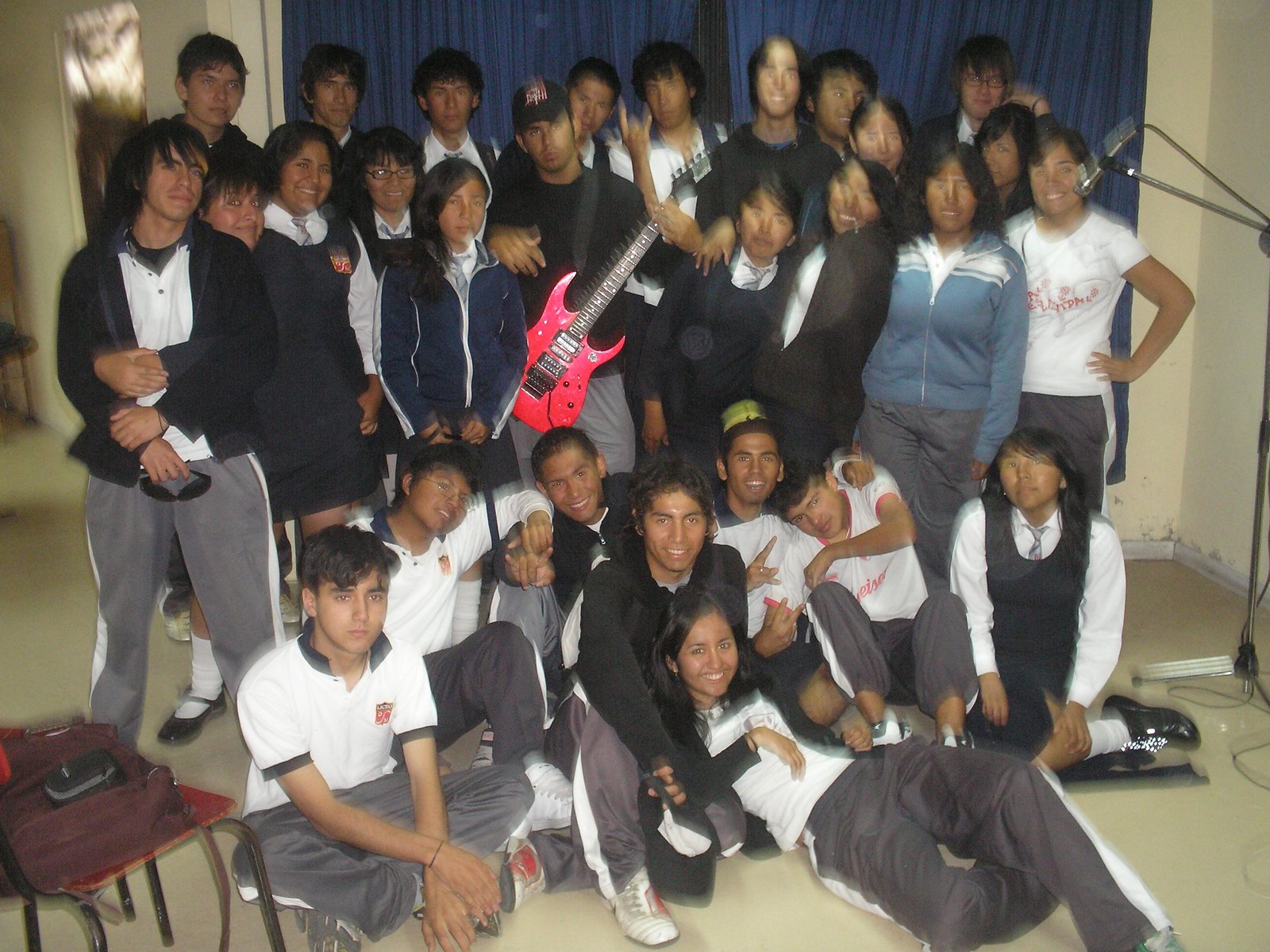
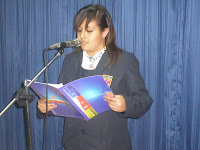
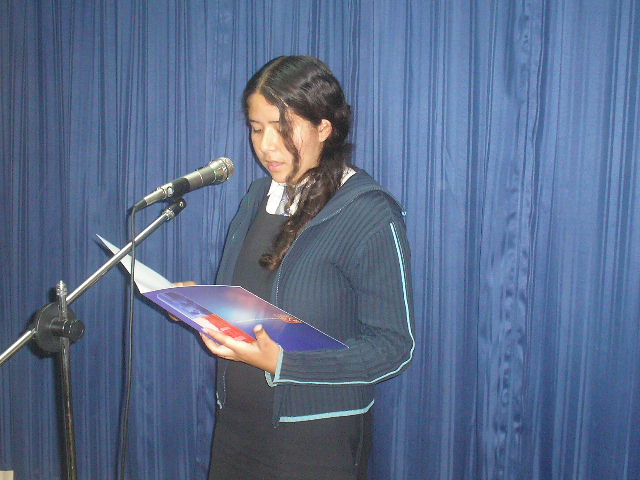
Last Wednesday, November 21 the students from Elective Class of English (11th graders) started the sessions of speeches en English. This year the theme was The most famous songs of all times.
The activity consisted in choose one of these songs and read it like a speech, changing the rythm, entonation, stress and sometimes the pronounciation to become the song in a formal discourse.


The audience listening carefully all the speeches.

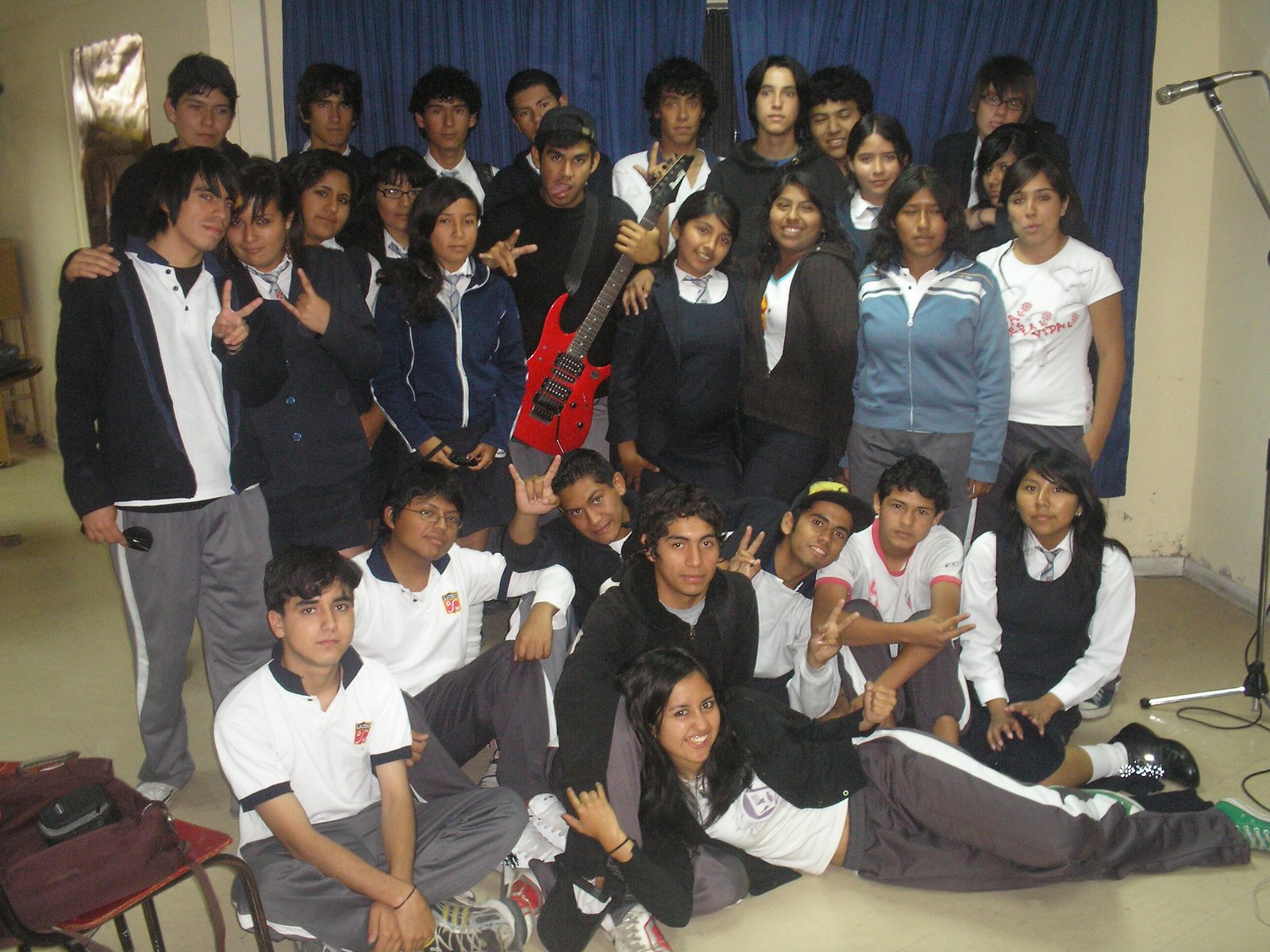
Lorena: Tramoya oficial del certamen

Youth Ambassadors in Arica

0 comments

Last Wednesday, November 14th, the students from the Elective Class of English participated in an Experience Presentation given by the five Chilean Secondary students who traveled to the United States last January as Youth Ambassadors, an initiative that was organized in Chile for the first time by non-profit organization Partners of the Americas and sponsored by the U.S. State Department.

Andrea Cifuentes Rodríguez from Iquique; Stephanie Dönicke Medina from Punta Arenas; Camilo Muñoz Arias from Teno; Ayleen Vásquez Celta from Arica; and Pablo Valenzuela Navarro from San Bernardo shared for several minutes their experiences in English before students from diferents Liceos and Colegios from Arica.

After the activity the elective class students took conversations in English with some of these travellers, interchanging opinions, ideas and even e-mail addresses.

This experience fullfilled all the expectations that the students of the Elective Class before going there.

Good job biys and girls.


Waiting...


The travellers sharing their experiences


Talking about music


Clarifying doubts and talking good English


Conversation in a high level


From one traveller to another. Great iniciative to talk.


Just fooling around!

Pump up the volume "questionnaire" (Cuartos Medios)

6 comments

This movie was used to make you think about your present, your future and your choices.

1. What's your opinion about the movie?
2. If, in the movie, the pirate radio was way used to "talk hard". Nowadays, which would be the way to say what you really think?
3. The movie plot ran about the fight against the system. According to your sense about the system... what do you think it still wrong and how you could change it.

"Almost Famous" (The Questions)

0 comments

Questionnaire

1. Why William was younger than his other classmates?
2. How William got interested in rock & roll?
3. For you, what’s the meaning of the phrase “IT’S ALL HAPPENING”. Who used it?
4. According to what you understood, what was the real function of being a “Band Aid”, like Penny Lane?
5. Why William’s mother was so overprotecting with him?
6. According to you, was Penny Lane really loved the guitar player (Russell Hammond)?
7. Why Russell, the guitar player, finally accept to publish everything?
8. What is the real name of Penny Lane? To whom did she say it?
9. William let him live his dream in the movie. What is your dream? and what are you doing to get it?
10. Why in the movie is used the name “Almost Famous”?

Questioning (Terceros Medios)

2 comments

According to the starting patterns to make a questionn given in class... Write 4 questions using each pattern.

... are you...
... were you...
... do you ...
... did you...
... will you...
... would you ...
... can you ...
... could you ...
... have you got ...
... have you been ...
... have you ever been ...
... are you going to ...


NOTE: Write them soon

Movie: "Pump up the volume" (Cuartos Medios)

0 comments

Teenage angst finds a new voice in this drama. By day, Mark Hunter (Christian Slater) is a quiet, studious student at an ordinary suburban high school in Arizona. But at night, Mark creeps down into his basement, fires up his pirate radio transmitter, and broadcasts to the community as Hard Harry, a sexually obsessed social commentator who passes along angry philosophy about the state of teenage life when not blasting punk rock or gangsta rap cuts. Hard Harry's sworn nemesis is high school principal Mrs. Cresswood (Annie Ross), who keeps SAT scores up at the expense of her students' dignity and individuality by eliminating "troublemakers" from the student body. Hard Harry's broadcasts, however, have become a rallying point for the school's misfit underclass, and Mrs. Cresswood is determined to track down the mystery student and bring him to justice (broadcasting without a license, he's not merely an annoyance, but a criminal). The war against Hard Harry intensifies when he broadcasts data from confidential school board reports; Mark's father is a school commissioner, but he has no idea what his son is doing in the basement. Meanwhile, Mark gains the attentions of Nora (Samantha Mathis), who has figured out who he becomes at night. More serious and intelligent than the average teen film.

NOTE: Questions about the film soon.

MR HOLLAND'S OPUS: "The Questions" (Cuartos Medios)

11 comments

1. According to you, give a reason that supports the artistic and musical education at school nowadays.

2. According to a former student (at the end of the movie), what is the real Mr Holland's OPUS? Why the word "opus" is used in the title of the movie?

3. What does the school principal -Mrs Jacobs- mean when she tells Mr Holland that a good teacher not only must teach knlowledge to the students, but also give them a compass?

4. Do you think that Mr Holand was a good father during the movie?
5. How does Cole's deafness interfere in his parents' marriage? ¿How did Mr Holland and his wife react to the stress?

6. According to you, what did it show the incident between Mr Holland and Rowena?

7. Did Mr Holland act properly saying Rowena that she had an outgoing talent and she had to go to New York and follow her dreams?
8. According to you, name the 5 most relevant moments of the film.


Recomendation...
Try not to write at the same time you are reading. I'd prefer you print or write the questions, answer them on a paper and then write them in the blog and upload them.

GAMES: "CHARADES"

37 comments

RULES OF CHARADES

Charades is a game of pantomimes: you have to "act out" a phrase without speaking, while the other members of your team try to guess what the phrase is. The objective is for your team to guess the phrase as quickly as possible.

Equipment
a stopwatch or other timing device
a notepad and pencil for scorekeeping
blank slips of paper
two baskets or other containers for the slips

Preparation
Divide the players into two teams, preferably of equal size. Divide the slips of paper between the two teams. Select a neutral timekeeper/scorekeeper, or pick members from each team to take turns. Agree on how many rounds to play. Review the gestures and hand signals and invent any others you deem appropriate.
The teams temporarily adjourn to separate rooms, to come up with phrases to put on their pieces of paper. These phrases may either be quotations or titles of books, movies, plays, television shows, and songs. Here are some suggested rules to prevent the phrases from being too hard to guess:
no team should write down any phrase unless at least three people on the team have heard of it;

no phrase should be longer than seven words;
no phrase should consist solely of a proper name (i.e., it should also contain other words);
no foreign phrases are allowed.
Once they have finished writing their phrases, the teams come back to the same room.

To Play
Each round of the game proceeds as follows:
A player from Team A draws a phrase slip from Team B's basket. After he/she has had a short time to review the slip, the timekeeper for team B notes the time and tells the player to start. Team A then has three minutes to guess the phrase. If they figure it out, the timekeeper records how long it took. If they do not figure it out in three minutes, the timekeeper announces that the time is up, and records a time of three minutes.
A player from Team B draws a phrase slip from Team A's basket, and play proceeds as above.
Normally the game continues until every player has had a chance to "act out" a phrase. The score for each team is the total time that the team needed for all of the rounds. The team with the smallest score wins the game.


Gestures
To act out a phrase, one usually starts by indicating what category the phrase is in, and how many words are in the phrase. From then on, the usual procedure is to act out the words one at a time (although not necessarily in the order that they appear in the phrase). In some cases, however, it may make more sense to try to act out the "entire concept" of the phrase at once.

To Indicate Categories:
Book title: Unfold your hands as if they were a book.
Movie title: Pretend to crank an old-fashioned movie camera.
Play title: Pretend to pull the rope that opens a theater curtain.
Song title: Pretend to sing.
TV show: Draw a rectangle to outline the TV screen.
Quote or Phrase: Make quotation marks in the air with your fingers.

To Indicate Other Things:
Number of words in the title: Hold up the number of fingers.
Which word you're working on: Hold up the number of fingers again.
Number of syllables in the word: Lay the number of fingers on your arm.
Which syllable you're working on: Lay the number of fingers on your arm again.
Length of word: Make a "little" or "big" sign as if you were measuring a fish.
"The entire concept:" sweep your arms through the air.
"On the nose" (i.e., someone has made a correct guess): point at your nose with one hand, while pointing at the person with your other hand.
"Sounds like": Cup one hand behind an ear.
"Longer version of :" Pretend to stretch a piece of elastic.
"Shorter version of:" Do a "karate chop" with your hand
"Plural": link your little fingers.
"Past tense": wave your hand over your shoulder toward your back.
A letter of the alphabet: move your hand in a chopping motion toward your arm (near the top of your forearm if the letter is near the beginning of the alphabet, and near the bottom of your arm if the letter is near the end of the alphabet).

Movie: Mr. Holland's Opus (Cuarto Medio)

0 comments

Mr. Holland's Opus is a 1995 drama film in which Richard Dreyfuss plays Glenn Holland, a musician and composer who takes a teaching job to pay the rent while trying to compose one memorable piece of music to make him famous.


The film features an orchestral score by Michael Kamen and many pieces of classical music. Kamen also wrote An American Symphony, the work Mr. Holland is shown working on throughout the movie.

The movie was written by Patrick Sheane Duncan (for which he received a Golden Globe nomination) and directed by Stephen Herek. Dreyfuss was nominated for an Oscar and a Golden Globe. It also stars Glenne Headly, Jay Thomas, Olympia Dukakis, William H. Macy, Alicia Witt, Terrence Howard, Jean Louisa Kelly, and Joanna Gleason.

**The questions will be uploaded after watching the movie in class.**

Movie: 'Almost Famous' (Tercero Medio)

3 comments

Almost Famous is a 2000 film written and directed by Cameron Crowe and released in 2000. It tells a fictional story of a teenage journalist initially writing for CREEM magazine and then later for Rolling Stone covering the rock band Stillwater, and his efforts to get his first cover story published. The film is semi-autobiographical, as Crowe himself was a teenage writer for Rolling Stone.

Despite very good reviews, the film was not a box-office success. The film received four Oscar nominations, one of which led to an award to Crowe for his screenplay. It was also awarded the 2001 Grammy Award for Best Compilation Soundtrack Album for a Motion Picture, Television or Other Visual Media. Roger Ebert hailed it as the best movie of the year.

The film itself is based on Crowe's experiences on tour with rock band The Allman Brothers Band, and somewhat about his tour with Led Zeppelin in the early 1970s. It is also based on him touring with Lynyrd Skynyrd. He even said that Ronnie Van Zant was a big basis on the movie. In the Rolling Stone article, he talks about how he lost his virginity, fell in love, and met his heroes, experiences that the main character William has in the movie.

The tagline for Almost Famous is "Experience It. Enjoy It. Just Don't Fall For It."

**The questions will be uploaded after watching the movie in class.**

Coupling Task 2 (Cuartos Medios)

7 comments

Read the vocabulary given in class and write about them. Describe where they were said, who said them, why said them and, if it proceeds, give the meaning of them.


  • Interview
  • Nudity projection
  • Giggle-loop
  • Minute silence
  • Appropriate
  • Break up
  • Funeral
  • Date
  • Corp
  • Cremate
  • Face cream
  • Naked

Funerals (Cuarto Medio)

6 comments

The death of someone is itself painful and sad. But a funeral is surrounded by many situations created not only by the friends and the friends' friends' friends of the family but also by the members of the family too.
This exercise is not done to satirize or ridiculize the funeral ceremony, but to demonstrate that every sad situation in our lives have always another face: a funny one.

Below, there is a list of what to do and what not to do in a funeral.
Read it and then aske the following question:

1. If you have assisted to a funeral. Have you seen any of the actions described below?
2. If you have never assisted to a funeral. How do you think you would feel assisting to one?
3. According to the "Coupling" episode, Do you believe in the theory of 'giggle-loop' explained in the episode? Have you ever passed through it any time?

Funeral Etiquette Do's and Don'ts for Funerals

Don't attend funerals of people you don't know.
Don't try to outdo the family's grief.
Don't use the occasion to "schmooze".
Don't videotape the service.
Don't ask for "just a peek-a-doodle" if it is a closed casket.
Don't rate the funeral with a 1-10 rating scale in front of the family.
Don't race the hearse to the cemetery.
Do offer your help, but don't charge for it.
Don't make statements like "something seems fishy to me" or "I hope they did an autopsy."
Don't remark that the deceased looks "way better than they ever did"
Don't sit in the front row of the church and lean over the seat to wave at everyone you know coming in.
Do realize that the grieving family probably knows the deceased more than you do: especially if it is your neighbour or your friend's aunt.
Don't approach the widow/widower and ask for the fifty dollars the deceased owed you.
Don't make an offer to the widow/widower on the deceased clothes.
Don't try to make the grieving family feel better by handing them a typewritten list of the deceased's faults.
Don't climb on headstones to get a better view.
Don't do impressions of the deceased.
Don't ask about the "eats" the minute you arrive at the funeral home.
Don't ask if there's any booze.
Don't use the word "rooked" if a discussion of funeral expenses arises.
Don't ask the widow/widower on a date at the funeral home.
Don't tell everyone how much your flower arrangement cost and offer to show them the bill if they don't believe you.
Don't remove anything from the coffin as a memento.
Don't tell the grieving family "it could be worse" and then go into a long rambling story about the passing of your little dog Blue.
Don't tell the relatives that this is the smallest funeral you've ever seen.
Don't use a fake name like "I.P. Nightly" in the guestbook.
Don't offer to make a beer-run.


DEADLINE: September 1st.

Listening Activity 1 (Terceros Medios)

13 comments

If you want listen again the national final debate in English 2006.

FINAL COMPETENCIA DE DEBATES EN INGLÉS 2006

Then, answer the following requests.


1. Write at least 2 arguments given for the proposition team, and explain them in your own words.
2. Write at least 2 arguments given for the opposition team, and explain them in your own words.
3. According to you... What team should have won the competition?
4. In which team you would be and why? tell me just one argument.

NEW ASSIGNMENT!! (TERCEROS Y CUARTOS MEDIOS)

0 comments


Boys and girls... The new assignment for this week (from August 6th to August 18th) is below the article about COOKING.


Bye.