Showing posts with label Tasks. Show all posts

TASK 2: Cuartos: ADVICES

10 comments

The four groups created in class (Freaky, Lazy, Spooky and Stinky) must send their respective advices.

In both, you'll have to write first the problem and then the advice or suggestion.
The best, I mean, the most complete and interesting advice will get the 7,0.

DEADLINE: FRIDAY, MAY 2nd, 2008.

SEE YA!!! BYE.

Pump up the volume "questionnaire" (Cuartos Medios)

6 comments

This movie was used to make you think about your present, your future and your choices.

1. What's your opinion about the movie?
2. If, in the movie, the pirate radio was way used to "talk hard". Nowadays, which would be the way to say what you really think?
3. The movie plot ran about the fight against the system. According to your sense about the system... what do you think it still wrong and how you could change it.

"Almost Famous" (The Questions)

0 comments

Questionnaire

1. Why William was younger than his other classmates?
2. How William got interested in rock & roll?
3. For you, what’s the meaning of the phrase “IT’S ALL HAPPENING”. Who used it?
4. According to what you understood, what was the real function of being a “Band Aid”, like Penny Lane?
5. Why William’s mother was so overprotecting with him?
6. According to you, was Penny Lane really loved the guitar player (Russell Hammond)?
7. Why Russell, the guitar player, finally accept to publish everything?
8. What is the real name of Penny Lane? To whom did she say it?
9. William let him live his dream in the movie. What is your dream? and what are you doing to get it?
10. Why in the movie is used the name “Almost Famous”?

Questioning (Terceros Medios)

2 comments

According to the starting patterns to make a questionn given in class... Write 4 questions using each pattern.

... are you...
... were you...
... do you ...
... did you...
... will you...
... would you ...
... can you ...
... could you ...
... have you got ...
... have you been ...
... have you ever been ...
... are you going to ...


NOTE: Write them soon

Movie: "Pump up the volume" (Cuartos Medios)

0 comments

Teenage angst finds a new voice in this drama. By day, Mark Hunter (Christian Slater) is a quiet, studious student at an ordinary suburban high school in Arizona. But at night, Mark creeps down into his basement, fires up his pirate radio transmitter, and broadcasts to the community as Hard Harry, a sexually obsessed social commentator who passes along angry philosophy about the state of teenage life when not blasting punk rock or gangsta rap cuts. Hard Harry's sworn nemesis is high school principal Mrs. Cresswood (Annie Ross), who keeps SAT scores up at the expense of her students' dignity and individuality by eliminating "troublemakers" from the student body. Hard Harry's broadcasts, however, have become a rallying point for the school's misfit underclass, and Mrs. Cresswood is determined to track down the mystery student and bring him to justice (broadcasting without a license, he's not merely an annoyance, but a criminal). The war against Hard Harry intensifies when he broadcasts data from confidential school board reports; Mark's father is a school commissioner, but he has no idea what his son is doing in the basement. Meanwhile, Mark gains the attentions of Nora (Samantha Mathis), who has figured out who he becomes at night. More serious and intelligent than the average teen film.

NOTE: Questions about the film soon.

MR HOLLAND'S OPUS: "The Questions" (Cuartos Medios)

11 comments

1. According to you, give a reason that supports the artistic and musical education at school nowadays.

2. According to a former student (at the end of the movie), what is the real Mr Holland's OPUS? Why the word "opus" is used in the title of the movie?

3. What does the school principal -Mrs Jacobs- mean when she tells Mr Holland that a good teacher not only must teach knlowledge to the students, but also give them a compass?

4. Do you think that Mr Holand was a good father during the movie?
5. How does Cole's deafness interfere in his parents' marriage? ¿How did Mr Holland and his wife react to the stress?

6. According to you, what did it show the incident between Mr Holland and Rowena?

7. Did Mr Holland act properly saying Rowena that she had an outgoing talent and she had to go to New York and follow her dreams?
8. According to you, name the 5 most relevant moments of the film.


Recomendation...
Try not to write at the same time you are reading. I'd prefer you print or write the questions, answer them on a paper and then write them in the blog and upload them.

Movie: Mr. Holland's Opus (Cuarto Medio)

0 comments

Mr. Holland's Opus is a 1995 drama film in which Richard Dreyfuss plays Glenn Holland, a musician and composer who takes a teaching job to pay the rent while trying to compose one memorable piece of music to make him famous.


The film features an orchestral score by Michael Kamen and many pieces of classical music. Kamen also wrote An American Symphony, the work Mr. Holland is shown working on throughout the movie.

The movie was written by Patrick Sheane Duncan (for which he received a Golden Globe nomination) and directed by Stephen Herek. Dreyfuss was nominated for an Oscar and a Golden Globe. It also stars Glenne Headly, Jay Thomas, Olympia Dukakis, William H. Macy, Alicia Witt, Terrence Howard, Jean Louisa Kelly, and Joanna Gleason.

**The questions will be uploaded after watching the movie in class.**

Movie: 'Almost Famous' (Tercero Medio)

3 comments

Almost Famous is a 2000 film written and directed by Cameron Crowe and released in 2000. It tells a fictional story of a teenage journalist initially writing for CREEM magazine and then later for Rolling Stone covering the rock band Stillwater, and his efforts to get his first cover story published. The film is semi-autobiographical, as Crowe himself was a teenage writer for Rolling Stone.

Despite very good reviews, the film was not a box-office success. The film received four Oscar nominations, one of which led to an award to Crowe for his screenplay. It was also awarded the 2001 Grammy Award for Best Compilation Soundtrack Album for a Motion Picture, Television or Other Visual Media. Roger Ebert hailed it as the best movie of the year.

The film itself is based on Crowe's experiences on tour with rock band The Allman Brothers Band, and somewhat about his tour with Led Zeppelin in the early 1970s. It is also based on him touring with Lynyrd Skynyrd. He even said that Ronnie Van Zant was a big basis on the movie. In the Rolling Stone article, he talks about how he lost his virginity, fell in love, and met his heroes, experiences that the main character William has in the movie.

The tagline for Almost Famous is "Experience It. Enjoy It. Just Don't Fall For It."

**The questions will be uploaded after watching the movie in class.**

Listening Activity 1 (Terceros Medios)

13 comments

If you want listen again the national final debate in English 2006.

FINAL COMPETENCIA DE DEBATES EN INGLÉS 2006

Then, answer the following requests.


1. Write at least 2 arguments given for the proposition team, and explain them in your own words.
2. Write at least 2 arguments given for the opposition team, and explain them in your own words.
3. According to you... What team should have won the competition?
4. In which team you would be and why? tell me just one argument.

Task 7: "South Americans reach energy deal"

31 comments

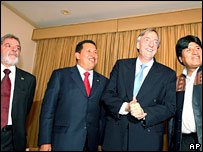
Argentina and Brazil have accepted Bolivia's moves to take state control of its gas industry but want talks on future prices and foreign involvement.

The deal was reached at an energy summit which also included Venezuela.
Earlier this week President Evo Morales took control of Bolivia's natural gas industry and told foreign firms to leave if they did not comply.
Brazil and Argentina rely on cheap gas imports from Bolivia and fear that nationalisation could push prices up.

Staying or going?
"The important thing is that gas supplies for the countries needing them have been guaranteed and that prices will be discussed in the most democratic form possible between all parties involved," Brazilian President Luiz Inacio Lula da Silva said following the meeting.

Correspondents say that while Mr Morales probably faced some stiff arguments from Argentine President Nestor Kirchner and his Brazilian counterpart President Lula, he was likely to have been supported by Venezuela's Hugo Chavez.

Venezuela has South America's largest reserves of oil and gas, and it has pledged to help Bolivia in the nationalisation of its own energy industry.

The Bolivian government has said it will start renegotiating energy contracts with all foreign companies from next week, giving them 180 days reach agreement, or face eviction.

They will be asked to hand over majority control of all Bolivian operations to the country's state oil firm, Yacimientos Petroliferos Fiscales Bolivianos.

State-owned Brazilian energy firm Petrobras, the largest foreign investor in Bolivian energy, had said it would cancel further investments, but President Lula said this decision could be reversed after more negotiations.

Spanish giant Repsol, which has invested more than 1bn euros in Bolivia, said it plans to remain in the country and co-operate with Mr Morales' government.

Article taken from: http://news.bbc.co.uk/2/hi/business/4974710.stm

1. What do you think about the article?
2. Bolivia's government took control of the natural gas industry. Who is worried for that? and Why?
3. Why did all these presidents meet in Argentina?
4. Write some new words found in the article.


DEADLINE: SATURDAY, MAY 13th.

Task 6: "The Story of Mother's Day"

21 comments

The earliest Mother's Day celebrations can be traced back to the spring celebrations of ancient Greece in honor of Rhea, the Mother of the Gods. During the 1600's, England celebrated a day called "Mothering Sunday". Celebrated on the 4th Sunday of Lent (the 40 day period leading up to Easter*), "Mothering Sunday" honored the mothers of England.

During this time many of the England's poor worked as servants for the wealthy. As most jobs were located far from their homes, the servants would live at the houses of their employers. On Mothering Sunday the servants would have the day off and were encouraged to return home and spend the day with their mothers. A special cake, called the mothering cake, was often brought along to provide a festive touch.

As Christianity spread throughout Europe the celebration changed to honor the "Mother Church" - the spiritual power that gave them life and protected them from harm. Over time the church festival blended with the Mothering Sunday celebration . People began honoring their mothers as well as the church.

In the United States Mother's Day was first suggested in 1872 by Julia Ward Howe (who wrote the words to the Battle hymn of the Republic) as a day dedicated to peace. Ms. Howe would hold organized Mother's Day meetings in Boston, Mass ever year.

In 1907 Ana Jarvis, from Philadelphia, began a campaign to establish a national Mother's Day. Ms. Jarvis persuaded her mother's church in Grafton, West Virginia to celebrate Mother's Day on the second anniversary of her mother's death, the 2nd Sunday of May. By the next year Mother's Day was also celebrated in Philadelphia.

Ms. Jarvis and her supporters began to write to ministers, businessman, and politicians in their quest to establish a national Mother's Day. It was successful as by 1911 Mother's Day was celebrated in almost every state. President Woodrow Wilson, in 1914, made the official announcement proclaiming Mother's Day as a national holiday that was to be held each year on the 2nd Sunday of May.

While many countries of the world celebrate their own Mother's Day at different times throughout the year, there are some countries such as Denmark, Finland, Italy, Turkey, Australia, Chile and Belgium which also celebrate Mother's Day on the second Sunday of May.

Text taken from http://www.holidays.net/mother/story.htm

1. What do you or your family usually do for the Mother's Day?
2. Name a historical sequence from the first to the nowadays Mother's Day.
3. Who were Rhea, Julia Ward Howe, Ana Jarvis, Woodrow Wilson? What did they do?
4. What do you plan to do for your Mom this year?

DEADLINE: SATURDAY, APRIL 29th.

Task 5: "Acne"

20 comments

Serious skin conditions affect around seven million of people in the UK alone.
They can cause significant emotional distress as well as physical discomfort.


What is it?

Acne is an inflammatory skin condition that causes spots.
Spots result from the build up of dead skin cells and grease that block the pores or hair follicles, typically on the face, upper arms, upper back and chest.

It is not contagious and is nothing to do with not being clean.
Hormonal changes, such as those related to puberty, menstruation and pregnancy, can contribute to acne.
Some medicines will also make it worse, including some contraceptive pills and steroids.

Who gets it?
Most people experience acne at some time in their lives, typically as young adults. Girls tend to develop it slightly earlier than boys - around the ages of 14-17 compared to 16-19 years, respectively.
Acne can occur later in life. Around five per cent of women and one per cent of men aged 25-40 continue to have acne after adolescence.

What are the symptoms?
As the pores of the skin become blocked, blackheads develop and small, tender, red spots appear. These can turn into pimples or whiteheads filled with pus.

What is the outlook?
Usually it is a mild condition, most commonly during young adulthood, and will resolve by itself. But for 15% of people it is severe.
The spots can become infected and cause significant scarring, particularly if they are scratched or squeezed.

How can it be treated?
Mild acne does not need treating as each inflamed spot will eventually heal. Eating a healthy diet and drinking plenty of water will help keep the skin healthy.
Keeping spot-prone areas clean by washing the affected area twice daily with an unperfumed cleanser can help. However, excessive washing and scrubbing of the skin will not help and may make the inflammation worse.

More severe acne may need treatment. The aim is to clear the spots and prevent scarring.
Treatments work by either unblocking blocked pores, reducing the amount of grease or sebum made by the skin, reducing the inflammation or fighting the bacterium that infects the lesions.
Creams, gels and lotions that can be applied to the skin are available to buy at pharmacies without a prescription. These usually contain antibacterial agents such as benzoyl peroxide, which also works by drying out the skin and encouraging it to shed the surface layer of dead skin.

There are several more potent oral tablets that can be prescribed by a doctor if the acne persists.

Make-up can be used to cover blemishes but heavy use of concealer may make acne worse.
Any scarring will improve with time. Laser therapy, chemical peels, dermabrasion and other treatments have been suggested for acne scarring.

Acne can be extremely distressing and it is important to seek help if you are anxious or depressed about it.

Article downloaded from http://news.bbc.co.uk/2/hi/health/medical_notes/4791176.stm

Questions
1. What do you think about the article?
2. Did you know something about the acne?
3. What do you do to fight against acne?
4. Write a list of 10 to 15 new words found in the text.

DEADELINE: April 21th, 2006, midnight.

Task 4: "Mobile phone TV begins in Japan"

20 comments

Mobile phone users in Japanese cities can now watch digital TV on compatible mobile phones for the first time.
The service is not the world's first, but it has the potential to be the biggest, by reaching more subscribers than in any other country.
Finding new phones in Japanese shops has proved difficult as only limited quantities have been produced so far.
Japan's 90m mobile phone users can already play video games, send emails and check websites on tiny handsets.
The new service has been carrying test transmissions for several months and will remain free while mobile operators assess its potential and the number of subscribers.
Broadcasters Nippon Television, Fuji Television and TV Asahi are among the companies which have signed partnerships with mobile operators.

'Preparing specific content'
"In the short-term, digital terrestrial broadcasting on mobiles with the same programming as normal televisions will be of little interest for us," said Masao Nakamura, the CEO of Japan's top mobile operator NTT DoCoMo.
"But we are getting ready by preparing new specific content for the service that could come into use later when new channels are available."
Japan's major mobile carriers say sales of compatible phones have been good, but they have not yet disclosed any figures.
Subscribers can watch up to nearly three hours of uninterrupted television with a normal battery.
1. What do you think about mobile-phones with all these gadgets included? Are they really useful?
2. Name all the functions that a mobile phone can have included nowadays.
3. Find the meaning of these following words:
reaching; assess; broadcasters; partnership; available; disclosed.
Remember, the deadline will be on Friday, April 14th.

TASK 3: 'How Telenovelas conquered the world"

25 comments

The telenovelas - Latin American soap dramas - are stereotypical, over the top and melodramatic - but, also, highly successful.
In fact, they are possibly the number-one form of human entertainment on the planet.
The facts are something to be reckoned with. This addictive formula has captivated audiences in Africa, Asia and Europe, and telenovela stars are mobbed at airports in Poland, Indonesia, China and the US.
Hundreds of millions of people watch telenovelas around the globe, everyday. Some go as far as saying two billion people - a third of the human race - are glued to these programmes on a daily basis.
But having been established on the simplest of formulas, they are now expanding their audiences by raising social issues.

'Love and logic'
Traditionally, most telenovelas tend to reproduce the same idea: one couple falls in love and have to fight disapproval and obstacles, until they end up together, usually on the last episode.
"You have the struggle between good and evil, between poor and rich, and this process of trying to finally fulfil your dream of a romantic relationship and live happily ever after," said Antonio La Pastina, professor of communications at Texas A&M University.
One indication of the degree to which they are taken seriously was given when women took to the streets in Venezuela protesting about a plot centring on a husband who cheated on his wife.
The writer was planning for the wife to forgive him in the last episode, but after he was threatened by some of the protesters in a grocery store, he changed the script to allow the wife to get a divorce.
Carla Estrada, one of the foremost telenovela producers in the world, said that a good script is the most important aspect of a successful telenovela.
"You need suspense, emotion, love and logic, in order to carry the story through 190 episodes," she said.
"It's not easy."
Sophisticated
According to some estimates, Mexico alone produces almost 3,000 hours of telenovelas each year, at a total cost of about US $250m - more or less the cost of, for example, the Hollywood film Titanic.
In the end, though, it is the audience who decides what really works.
"The telenovela has managed to create a very loyal market," Ms Estrada explained.
"They're loyal to a market that thinks of them. It's like having a daily date with someone.
"For some people, the telenovela is like their own life - and this is a continuing process that creates a feeling of belonging and identity."
And now, people are beginning to see the telenovela as a tool for social change.
Even the producing countries have now developed styles of their own. Venezuelan telenovelas are designed purely for entertainment.
Meanwhile Mexican ones tend to be the more melodramatic, and are very conservative. Colombian telenovelas tend to show the diversity of the country - with a feeling of more contemporary issues, like corruption, transvestites and greed, and with the use of irony and comedy.
It is worth remembering also that it was the Colombians who broke with the mould of telenovelas by producing the enormously successful Betty the Ugly, where the main character, as the name suggests, wasn't the prettiest girl in town.
The Brazilian soaps, however, are more sophisticated, with different stories, like human cloning or love between Muslims and Christians and more of the social realism.
When one soap - Family Ties - dealt with a character who needed a bone marrow transplant after getting leukaemia, the Brazilian attitude towards organ donation was completely changed.

Cultural influence
And beyond the world of dreams, some telenovelas, it seems, have began to push the envelope a bit further and deal with issues that before were considered taboo.
For decades, the main telenovelas producers in Mexico and Brazil were often criticised for being aligned with the political powers of the moment and not allowing any criticism of the government.

But the opposite is also happening, says Maria Luisa Alves, of Mexico's Television Azteca.
"They have started making more political telenovelas," she says.
"More controversial events are being included in the Mexican telenovela - and that is a new trend. They have featured homosexuality, having a child with special needs, abortion, and sex before marriage. In a very Catholic society, I think that is a lot to say on public television at prime time."
And the more global telenovelas become, the bigger the cultural influence they seem to have.
But regardless of the weakness or the strengths of this very Latin American product, the truth is that millions of people around the globe, love them.
"For an hour, six times a week, we can forget about our sorrows, our fears, our personal little mysteries - and embrace a wonderful love story that works as a balm for our souls," explains Carolina Espada, one of the main writers for Venevision, the main telenovela producer in Venezuela.
"Long live the Telenovelas."

Questions:
1. Did you know how popular were the american telenovelas around the world?
2. What do you think about them? Do you like them?
3. Why are the telenovelas so popular?
4. Write some new words you found in this article.

DEADLINE: Friday 7, April, 2006

Task 2: Pupils 'Learn from Foetal Moves' (Deadline: March 31, 2006)

28 comments

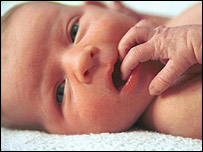
Children who do daily exercises, mimicking a baby in the womb, have shown dramatic improvements in maths and English, new research suggests.
The technique, Primary Movement, has been championed by Dr Martin McPhillips from Queen's University Belfast.
Until recently, it had not been formally tested. But the first academic study has startled the sceptics.
Primary Movement is based on the fact that while they are still in the womb, babies are practising for life outside.
They go through a range of movements and reflexes while they are still foetuses, but usually grow out of them by the time they are one year old.
However, some never get past the habits formed as a foetus.
For some reason, that has been shown to hold back their school work.
However, getting pupils to mimic those baby movements every day in class is said to bring astounding improvements.
Dr McPhillips, a psychologist who developed the programme, said: "We adapted the foetal movements for school children.
"Sometimes we disguised them in songs and dance. The programme is a re-enactment of foetal life."

He admitted that it sounded "a little ridiculous".
"But when you see the foetus move, it does make a lot more sense," he said.
"These are very powerful movements and they are at a critical point in development when so much of the central nervous system for example is being laid down."
Many primary schools have tried the movement therapy but, until recently, there had been no formal research.
Progress followed
However, a new study has measured the effect of the special daily exercises.
Dr Julie-Anne Jordan-Black followed the progress of 1,000 children from 13 schools.
"Some children received the primary movement programme, some didn't and they were a control group," she explained.
"The results have shown that the children who received primary movement significantly increased their standard score in maths, spelling and reading."
Schools involved in the study reported good results. Karen Smyth of Holy Family school in Teconnaught, County Down, is an enthusiast.
She reported jumps in standardised scores following the use of primary movement.

"We would have seen standardised scores jumping in English from about 93 to over 110, which was massive.
"Normally, the child would move two to three points from year to year," she said.
"Maths was the same. It went right through from lower ability children to the top of the class."
The research was paid for by the Council for the Curriculum, Examinations and Assessment (CCEA).
However, before it is introduced across Northern Ireland, Carmel Gallagher from CCEA wants more proof that it really works.
"The research is coming through quite strongly that this movement programme has an impact on children's reading age," she said.
"But let's make sure that this is the case, can this research be replicated outside Northern Ireland and then, if absolutely proven, I think that CCEA and the Department of Education would be hugely interested in seeing something like this applied right across the education system."
The researchers said they had now done that and a study in Australia has been completed which shows similar improvements to those reported by teachers in Northern Ireland.


Article taken from http://news.bbc.co.uk/2/hi/uk_news/northern_ireland/4828146.stm
make some comments about the article.
What do you think about it? Are you agree with it?

Task 1: "Music Lessons for the Brain"

32 comments

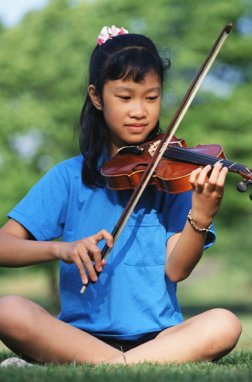
Learn to play the piano. Join your school band or sing in a musical. Take some guitar lessons and start a rock group. If people wonder what you're up to, tell them you're doing something important. You may be making yourself a little bit smarter.
A new study shows that young children who learn to sing or play a musical instrument may gain a slight mental edge over kids who don't take music lessons.
Taking music lessons may help you become a little bit smarter.
The study involved 132 first graders in Canada. The researchers, from the University of Toronto at Mississauga, randomly divided the students into four groups. One group took weekly piano lessons. Another group took singing lessons. The third group went to drama class. And the last group did no extracurricular activities for the entire school year.
All the participants took IQ tests at the beginning and at the end of the first grade. Overall, average scores went up for all groups. But kids who took piano or singing lessons gained more. Their IQ scores went up 7.0 points on average, compared with 4.3 points for kids in the other two groups.
It's a tiny difference, really, and the music students probably won't end up getting higher grades or having greater success later in life.
Still, the results are worth noting, the researchers say. Learning to play music teaches kids how to pay attention and memorize things, and it helps fine-tune coordination and other physical skills. These types of experiences may have positive effects on the developing brains of young people.
So grab a guitar, a trombone, or a violin. At the very least, you'll help fill the world with beautiful sounds. Who can argue with that?—E. Sohn

This article was taken from http://www.sciencenewsforkids.org/articles/20040623/Note2.asp

Make some comments about this article based on this questions:
- Have you learnt to play any musical instrument? Which one?
- Are you agree with this article?